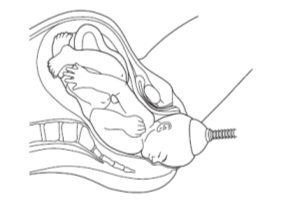
In the UK about 12% (one in eight) pregnant women need assistance during labour. An assisted vaginal birth is when help is needed to deliver the baby at the very end of labour and when the cervix is fully dilated. It involves your midwife using instruments (either ventouse or forceps) to pull your baby out.
The main reasons why you may need an assisted birth are:
- Your baby has become distressed during the pushing stage
- You are exhausted and are unable to continue pushing
- There is a medical reason why you cannot push for a long time
- Your baby is not travelling through your pelvis and birth canal
- Forceps may be used to guide your baby’s head in a breech birth: where your baby is born feet first.
What will happen if I need an assisted birth?
Before an assisted birth, you will be explained the reasons why your midwife feels you need help, you will be examined internally and your bump will be checked to ensure that baby is in a good position for an assisted birth. Your midwife will then make her decision as to what tool to use and which is likely to be most effective.
Sometimes, your midwife may feel that there is a risk that you may need a caesarean and in this case, you will be moved to an operating theatre so that a caesarean section can be carried out if needed, though being in theatre does not mean it will definitely happen.
You will need to get into position for an assisted birth. You will need to move down the bed and put your legs in stirrups (supports) so that your legs are open. Your legs and stomach area should then be covered with a sterile sheet. You will need an empty bladder and in most cases a catheter will be put into your bladder to empty it. Some women find this slightly uncomfortable.
You will be given pain relief before the procedure: this may be a local anaesthetic or an epidural or a top up if you have already had an epidural.
A paediatrician may also been called in to witness the birth. There is no need for you to worry as this is common procedure in most hospital when using instruments for an assisted birth. (A paediatrician is a doctor who specialises in the care of babies and children.)
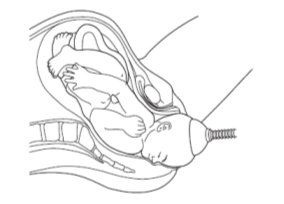 A Ventouse delivery
A ventouse or a vacuum extractor has a cup attached to a small vacuum pump and a handle. The cup may be made of metal or either a soft or hard plastic and fits on the top of your baby’s head, near the back. The machine is switched on and the cup vacuums onto your baby’s head. As you push, your midwife will gently pull the baby out.
A ventouse delivery is often the preferred method of assisted birth as compared to a forceps birth it is less painful for you during the procedure and also during the recovery period. There is also less risk of you needing an episiotomy or receiving a perineal tear, this is because the cup sits on top of your baby’s head and not around it thus meaning it needs less room.
If ventouse is not successful in getting baby out, forceps may also be tried before your midwife recommends a caesarean. A ventouse delivery is not used if you are under 34 weeks pregnant as your baby’s head will be too soft for the suction cup.
A Forceps Delivery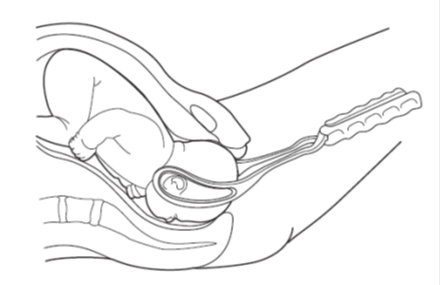
Forceps look like tongs made from a smooth metal and are curved so that they fit around baby’s head. Your midwife will place the tongs around baby’s head and like the ventouse delivery will gently pull with each contraction you have.
In almost all forceps deliveries, your midwife will need to make an episiotomy to enlarge your vagina to make space for the forceps. Your midwife will gently pull for three contractions, after this the forceps will be removed and you will most likely need a caesarean.
Forceps are the more successful tool for assisted birth with a much higher success rate than ventouse. However, forceps tend to be more painful and uncomfortable for you and it is possible that you may suffer from damage to your pelvic floor or perineum.
After an assisted birth
It is possible that the tools used for an assisted birth can leave a temporary mark on your baby. During ventouse, the suction cup can leave a mark on your baby’s head called a chignon or there may be a bruise on the head and this is called a cephalohaematoma: both marks will disappear fully. Forceps can also leave a mark on your baby and often on the face, but again this mark will disappear.
You may need to leave the catheter attached for up to 24 hours after an assisted birth and may need a course of antibiotics which are used to prevent any blood clotting.
It is important that you understand why you need an assisted birth and it to realise that 4 out of 5 women who had an assisted birth do not need an assisted birth during their next labour. If you have any questions regarding your assisted birth, you should speak to your midwife who will be able to explain and describe your delivery and help you to feel more at ease.
You are likely to feel bruised and sore and if you needed an episiotomy your stitches and swelling may make you uncomfortable. See Episiotomy for more information and for ways to help with pain and healing.
Diagrams taken from www.nhs.uk and Royal College of Obstetricians and Gynaecologists
by Jenny, mum to William and James