An Amniocentesis is a non-compulsory test that can be carried out on your unborn baby between the 15th and 20th week of pregnancy. The test is used to check whether the unborn baby may develop or has developed any abnormalities including:
- Down’s Syndrome
- Spina Bifida
- Sickle Cell anaemia
- Cystic Fibrosis
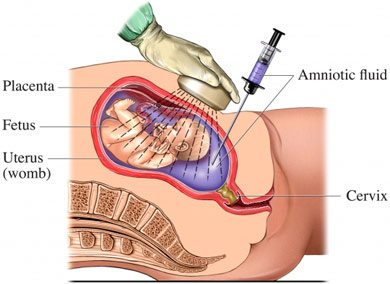
The aim of an amniocentesis test is for the doctor take a sample of the amniotic fluid which surrounds your baby in order for it to be tested under laboratory conditions. Amniotic fluid is the liquid around your unborn baby inside the womb and contains many cells from your baby as well as any waste that has been produced.
Before you decide whether or not to have an amniocentesis test, you will talk to your midwife or doctor about the risks of the test as well as the benefits. Unfortunately, an amniocentesis test does carry a slight risk of miscarriage and you will be able to discuss this in detail with your midwife and will be required to sign a consent form before the test can be carried out. There is also a small risk of infection after the procedure.
Your midwife may recommend you to have a test if you are at a higher risk of your child having problems. However, you must remember that only you can make the final decision as to whether or not you have the test. You may be at a higher risk if:
- You have previously had a baby born with abnormalities
- There is a family history of conditions
- You are over 35 years of age
- A previous screening test or ultrasound suggested that your baby may have a problem
If you are testing due to a high risk of your baby inheriting abnormalities, you may offered Chorionic Villus Sampling (CVS) instead as this test can be carried out earlier that then 15th week of pregnancy and give you an earlier diagnosis.
What happens in an amniocentesis test?
An amniocentesis test should only take 15 minutes to perform although if your baby is very active and moves around a lot, the test may take longer. The test is not painful although may be uncomfortable with a slight stinging feeling, some women describe it as a period type pain.
Some women decide to have a local anaesthetic injected into their abdomen in order to numb the area although this is not necessary if you prefer not to. Your abdomen will be cleaned with an antiseptic solution in order to avoid any infection.
You will have an ultrasound scan before the test is carried out and often during as well as the scan can check the position of the baby and help the doctor to locate where the amniotic fluid is and check that the needle is entering the womb safely.
A long, thin needle will then be inserted through your abdominal wall which is likely to cause a stinging feeling. A syringe will then be used to remove a sample of the amniotic fluid. In approximately 8% of tests, not enough amniotic fluid is collected and the needle will need to be re-inserted and more amniotic fluid collected.
Your baby’s heartbeat will be monitored throughout the test by your midwife.
After the test, you will be advised to rest for 24 hours and you may suffer from cramps and some spotting. You should also make sure that you have someone with you to take you home as you should not drive yourself. If you have any concerns after your test always talk to your midwife although you should get urgent medical help if you:
- Are bleeding from your vagina
- Have a high temperature of 38 degrees or above
- Are shivery
- Have clear watery fluid leaking from you vagina (not urine)
- Are having contractions
- Have lower back pain or abdominal pain that does not ease.
After the test is carried out, you will be told about how you will get the results and how long they should take, they may take up to three weeks. Most test result come back to indicate that the baby is fine although if the results return with a chance that the baby may have a problem, you will see a specialist who will be able to talk you through your next stages and available options. Some women decide to terminate their pregnancy and others decide to continue, whatever your decision, you will receive the full support and advice of your medical team.
by Jenny, mum to William and James